

Key Questions Board Members Ask CEOs About AI Implementation
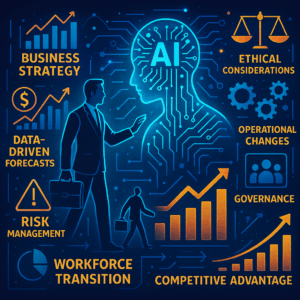
We are hearing that CEOs are under increasing pressure from their Boards to create plans for the implementation of Artificial Intelligence hashtag#AI in their organisations.
Here are some of the key questions that board members typically ask CEOs and how we know that LINQ Ltd. can help.
1️⃣ Strategic Alignment and Purpose of AI
Boards seek to ensure that AI initiatives align with the company’s core business strategy and goals, avoiding projects that are merely technology-driven:
– How is AI integrated into our company’s core business strategy?
– What business problem are we trying to solve with AI?
💥LINQ aids CEOs in ensuring AI projects are grounded in real business needs by simulating applications of AI to confirm alignment with strategic objectives
2️⃣ Financial Impact and ROI
Financial implications are a primary concern for boards, who ask about costs and expected returns:
– What is the total cost of this AI initiative, and what return on investment (ROI) can we expect?
– How will we measure the success of our AI programs?
💥LINQ supports this by providing data-driven forecasts of AI’s financial impact, allowing for realistic ROI projections
3️⃣ Risk Management and Ethical Considerations
The introduction of AI raises various risks and ethical dilemmas that boards must oversee:
– What is our approach to Responsible AI and managing AI-specific risks?
– Are we in compliance with current and upcoming AI laws and regulations?
💥LINQ helps identify potential risks during planning and ensures that ethical considerations are embedded in AI processes
4️⃣ Operational Changes and Workforce Impact
AI adoption can significantly alter organisational operations:
– Is our organisation prepared to implement AI?
– Do we have the right talent and skills to succeed in AI implementation?
💥LINQ provides insights into how roles and workflows will change, assisting in workforce transition planning
5️⃣ Governance and Oversight of AI Initiatives
Boards are concerned with governance structures for AI:
– Who is responsible for AI governance and oversight in our organisation?
– Do we have the proper policies and controls to govern AI use?
💥LINQ facilitates clear accountability and documentation of AI processes, supporting governance efforts
6️⃣ Staying Competitive and Future-Focused
Finally, boards want to ensure that AI initiatives position the company for future success:
– How will AI give us a competitive advantage?
– How do we stay current with fast-changing AI innovations?
💥LINQ enhances agility in responding to market changes and helps identify long-term strategic opportunities
Boardroom pressure becomes opportunity with the right plan. Armed with LINQ, CEOs can turn AI from a daunting mandate into a dynamic advantage, confidently leading their organisations into an innovative, appropriately AI-powered future.
We’ve written more – expanding on each of these 6 topics. Read the full whitepaper here.